
Blood test for weight loss: your GLP-1 baseline
Your starting point before the first injection: blood sugar, cholesterol, pancreas, liver, kidneys, thyroid and nutrients in one measurement.
Add to your order
No referral needed
Added to your order
Click the button to view your cart
Included Markers
21 markersInsulin (Fasting), ALT (Alanine Aminotransferase), TSH (Thyroid Stimulating Hormone), AST (Aspartate Aminotransferase), HDL Cholesterol, HbA1c (Glycated Hemoglobin), Bilirubin (Total), ApoB (Apolipoprotein B), Vitamin B12, Ferritin, Potassium, Sodium, Glucose (Fasting), Total Cholesterol, Albumin, Lipase, Creatinine, Vitamin D (25-OH), Triglycerides, Bilirubin (Direct), Bilirubin (Indirect)
Are you about to start a weight-loss injection such as Ozempic, Wegovy or Mounjaro, or are you already using semaglutide or tirzepatide? This blood test for weight loss is designed as your baseline: a starting point that lets you see what changes later on.
This GLP-1 baseline panel looks at a number of values across your blood sugar, cholesterol, liver, kidneys, thyroid and nutrients in a single blood draw. You order online, need no referral, and receive your results within a few working days with an assessment by a BIG-registered doctor.
Why this test?
Losing weight with GLP-1 medication changes a lot in your body at once: you eat less, your weight goes down and your metabolism adjusts. A baseline beforehand records how your values look now, so a later check has something to compare against.
Without a starting point, a result is harder to place. With a baseline blood test as your reference, you and a doctor can more easily see which values move along with your journey.
Who is this test for?
- People who are about to start a weight-loss injection and want to record a starting point
- People who have just begun semaglutide or tirzepatide and want to know their baseline values
- People who want their blood sugar, cholesterol, liver, kidneys and vitamins measured in one go
- People who want to arrange this without a referral
This blood test does not determine whether a weight-loss injection is suitable for you. That assessment always belongs with a doctor.
What is tested?
- Blood sugar and insulin: HbA1c, fasting glucose and fasting insulin.
- Cholesterol and fats: total cholesterol, HDL, triglycerides and ApoB.
- Liver: ALT, AST, bilirubin and albumin.
- Kidneys and minerals: creatinine, sodium and potassium.
- Thyroid: TSH.
- Pancreas: lipase.
- Nutrients: vitamin D, vitamin B12 and ferritin.
What can this test tell you?
Your blood sugar and insulin values can offer insight into your metabolism before you start. Your cholesterol and triglyceride values can provide context around your heart and vascular health, and your liver and kidney values give a view of how those organs are doing at that moment.
Because a weight-loss injection can strongly reduce appetite, nutrients such as vitamin D, vitamin B12 and ferritin may be relevant to know as a starting value. Together these are a snapshot, not a diagnosis, that you can discuss with a doctor.
How is the sample collected?
Blood is drawn at a certified collection point. In the Netherlands there are 700+ locations, which you choose yourself after ordering.
This is a blood test without a GP: you pick a location and a moment that suits you. The draw usually takes only a few minutes.
When is this test useful?
This baseline can be useful just before you begin a weight-loss injection, or in the first weeks after starting. That way you record your starting values at a moment when little has changed yet.
If you want to keep following your values over time, a later check fits well with this. Some people choose to test periodically to stay informed.
What do the results mean?
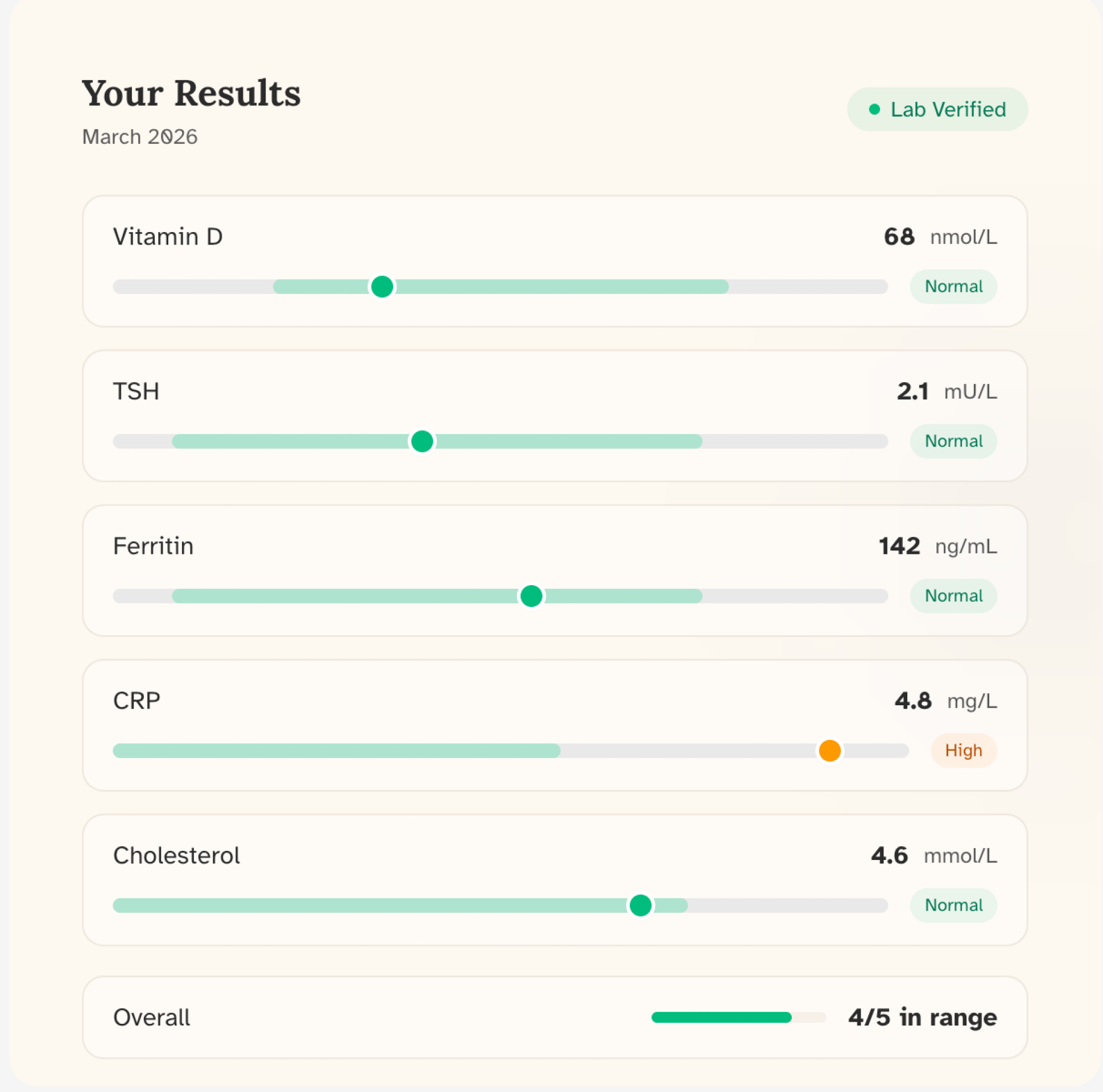
Your results appear with a reference range for each marker. Values outside that range are worth discussing with a doctor, who can place them in the context of your lifestyle, diet and weight-loss journey.
A single value outside the range does not immediately point to a problem. It is about the overall picture, and often about the change compared with your baseline.
What happens after the results?
Your results are usually in your personal dashboard within a few working days, with the measured values next to the reference ranges. You view them whenever it suits you.
Every blood test result includes a professional assessment from a BIG-registered doctor. For treatment decisions, discuss your results with your GP.
Frequently Asked Questions
For reliable glucose, insulin and triglyceride values it is usually necessary to fast for 8 to 12 hours. Drinking water during that period is fine.
No. You arrange this blood test for weight loss without a referral and choose your own collection point. You can then discuss the results with your GP.
No. A blood test gives measured values, not a diagnosis. Whether a weight-loss injection is suitable for you is always assessed by a doctor.
Many people choose to test just before starting a weight-loss injection, or in the first weeks after, so they have a starting point to compare later values against.
What We Test
| No. | Biomarker | Unit | Turnaround |
|---|---|---|---|
| 01 | Insulin (Fasting) | pmol/L | 5 days |
| 02 | ALT (Alanine Aminotransferase) | u/l | 1 day |
| 03 | TSH (Thyroid Stimulating Hormone) | mu/l | 2 days |
| 04 | AST (Aspartate Aminotransferase) | u/l | 1 day |
| 05 | HDL Cholesterol | mmol/l | 1 day |
| 06 | HbA1c (Glycated Hemoglobin) | mmol/mol | 2 days |
| 07 | Bilirubin (Total) | umol/l | 4 days |
| 08 | ApoB (Apolipoprotein B) | g/l | 4 days |
| 09 | Vitamin B12 | pmol/l | 3 days |
| 10 | Ferritin | ug/l | 2 days |
| 11 | Potassium | mmol/l | 2 days |
| 12 | Sodium | mmol/l | 2 days |
| 13 | Glucose (Fasting) | mmol/l | 1 day |
| 14 | Total Cholesterol | mmol/l | 1 day |
| 15 | Albumin | g/l | 2 days |
| 16 | Lipase | u/l | 6 days |
| 17 | Creatinine | umol/l | 1 day |
| 18 | Vitamin D (25-OH) | nmol/l | 3 days |
| 19 | Triglycerides | mmol/l | 1 day |
| 20 | Bilirubin (Direct) | umol/l | 2 days |
| 21 | Bilirubin (Indirect) | umol/l | — |
| Your result arrives once the slowest test is finished: 6 days. This is indicative; turnaround varies per laboratory. | |||
Preparation
-
Been ill? Wait a little
RequiredHad a fever, an infection or a vaccination in the past 2 weeks? Wait with the draw until you are fully recovered. These values react to inflammation and would give a distorted picture.
-
Pause biotin
RequiredDo you take a supplement with biotin (vitamin B8, common in hair, skin and nail supplements)? Stop it 72 hours before the draw. Biotin interferes with the measurement of these values.
-
No hard training beforehand
RequiredNo heavy training, long endurance sessions or anything that leaves you out of breath in the 48 hours before the draw. Normal walking is fine.
-
No alcohol beforehand
RequiredDrink no alcohol in the 24 hours before the draw.
-
Come fasting
RequiredFrom 22:00 the evening before, eat and drink nothing except water. That is at least 8 hours. Skip coffee, tea, chewing gum and smoking that morning. Plan the draw before 10:00.
-
Timing worth knowing
Good to knowIf you repeat this test, pick the same time of day each time so the results compare.
- Water is always fine. Drink as usual beforehand, it makes the draw easier.
- Take your usual medication, unless your own doctor told you otherwise.
Extend this panel
Same draw, no second appointment.
Related Measurements
Insulin Resistance (HOMA-IR)
Insulin resistance becomes more relevant with age. Track it with fasting glucose, insulin and your HOMA-IR score.
GLP-1 Check-in Panel
The 3-month safety and progress check clinics do: pancreas, liver, kidneys, salts and your metabolic progress on GLP-1 medication.
GLP-1 Extended Panel
The 6-month measurement: everything from the check-in plus insulin, ApoB and your nutrients — especially relevant if you have been eating much less for a while.