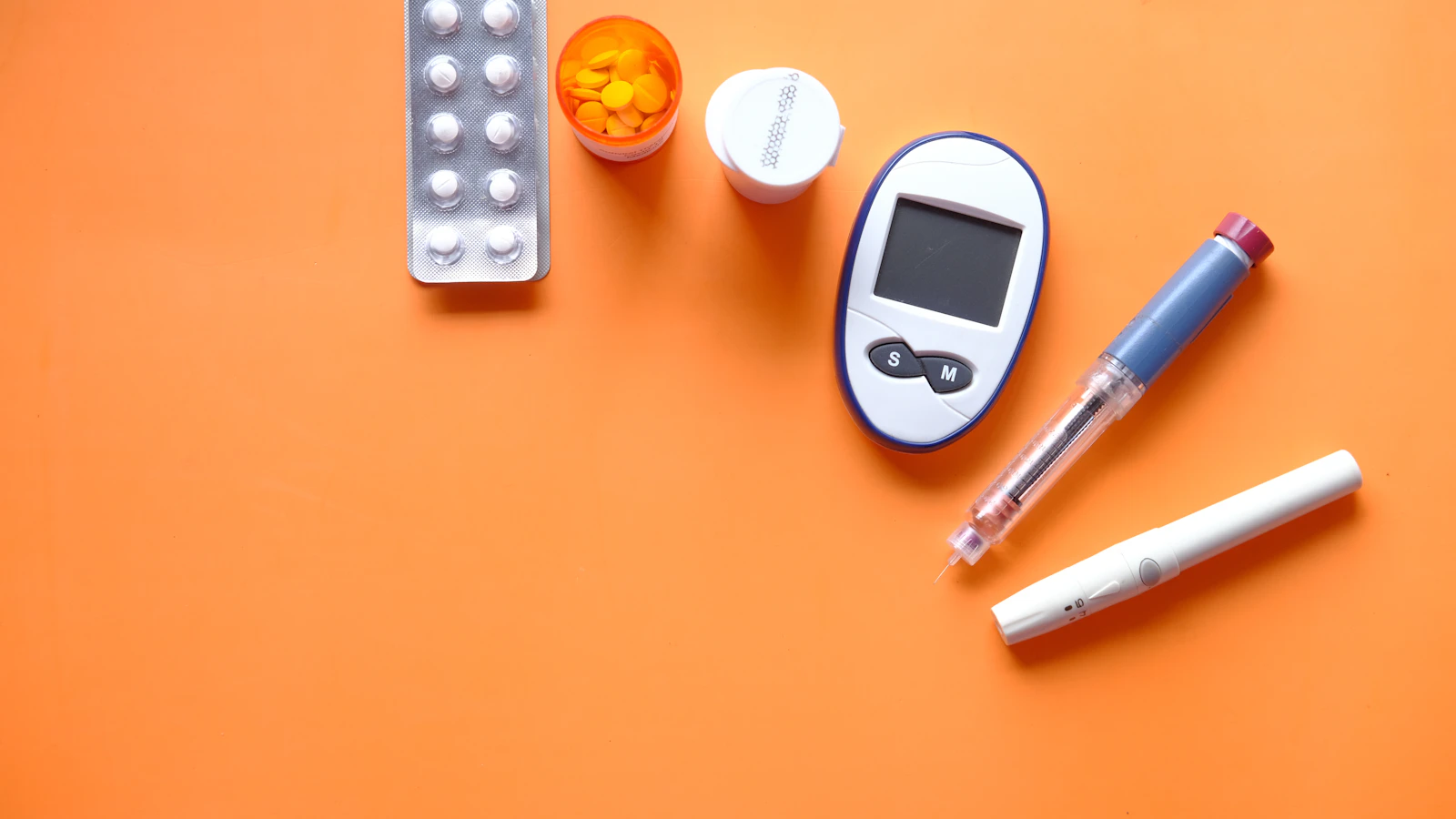
Liraglutide is a GLP-1 drug sold under two brand names: Saxenda for weight management and Victoza for type 2 diabetes. It is the same substance at a different dose, and unlike the newer drugs it has to be injected every day.
That daily rhythm is the main reason liraglutide is losing ground to semaglutide and tirzepatide.
It is also the drug whose two brand names most Dutch pages mix up, which leaves people comparing doses that are not comparable.
What is liraglutide and how does it work?
Liraglutide resembles the gut hormone GLP-1, which your body produces after a meal. It stimulates insulin release, suppresses glucagon, slows stomach emptying and dampens the hunger signal in the brain. The result is that you feel full sooner and stay full longer.
The mechanism is the same as with Ozempic and Wegovy; only the duration of action differs.
That shorter duration is exactly why liraglutide has to be daily. Semaglutide stays active for roughly a week, liraglutide for roughly a day. The Dutch Farmacotherapeutisch Kompas describes the titration schedule, which for Saxenda steps weekly from 0.6 mg to 3.0 mg.
How the mechanism works in detail sits in GLP-1 injection.
What is the difference between Saxenda and Victoza?
The dose and the registered indication, not the substance. Saxenda goes up to 3.0 mg per day and is registered for weight management. Victoza goes up to 1.8 mg per day and is registered for type 2 diabetes. For reimbursement that difference decides everything.
| Drug | Substance | Frequency | Maximum dose | Registered for |
|---|---|---|---|---|
| Saxenda | Liraglutide | Daily | 3.0 mg | Weight management |
| Victoza | Liraglutide | Daily | 1.8 mg | Type 2 diabetes |
| Wegovy | Semaglutide | Weekly | 2.4 mg | Weight management |
| Ozempic | Semaglutide | Weekly | 2 mg | Type 2 diabetes |
| Mounjaro | Tirzepatide | Weekly | 15 mg | Type 2 diabetes |
Do not compare the milligrams across these rows. Each substance has its own potency, so 3.0 mg of liraglutide is not stronger than 2.4 mg of semaglutide.
How much weight do you lose with liraglutide?
On average around 8 kilos over more than a year, and less than with the newer drugs. In the SCALE trial participants on 3.0 mg liraglutide lost an average of 8.4 kilos after 56 weeks, against 2.8 kilos on placebo. 63.2% passed 5% weight loss and 33.1% passed 10% (Pi-Sunyer et al., 2015).
For comparison, tirzepatide reached 20.9% after 72 weeks in SURMOUNT-1 (Jastreboff et al., 2022).
On blood sugar liraglutide has been overtaken too. In PIONEER 4 even the semaglutide tablet produced a slightly larger HbA1c reduction than the liraglutide injection (Pratley et al., 2019).
The drug is not disappearing though, and that has practical reasons: availability, familiarity among doctors, and the fact that a daily dose is easier to interrupt if someone tolerates it badly.
The full comparison of the drugs sits in weight-loss medication, and the tablet version is covered in Rybelsus experiences.
What side effects does liraglutide have?
Mainly gastrointestinal: nausea, diarrhoea, constipation and vomiting. For most people these fade within days to weeks, and they usually return at each dose increase. Rarer but more serious are problems with the pancreas and the gallbladder.
Persistent severe abdominal pain radiating to the back is a reason to contact your GP, not to wait it out. The Dutch health information service Thuisarts advises always consulting your GP about new or persistent abdominal complaints during medication use.
The full list of complaints, with what is measurable for each, sits in Ozempic side effects. The substances differ, the family of complaints does not.
Which blood values go with liraglutide?
The sugar system first, with the pancreas as the point of attention. HbA1c is the value this drug is judged on in diabetes, and it only moves after eight to twelve weeks. Fasting insulin responds faster, often within weeks.
Lipase is the value rarely mentioned and still worth having as a starting point, because the pancreas is a known point of attention across the whole GLP-1 group.
Daily injectors have one practical advantage here: a missed day disturbs less with liraglutide than with a weekly drug.
Our GLP-1 baseline panel records that starting point before the first injection changes what you measure, assessed by a BIG-registered doctor.
What strikes me is that liraglutide is now mostly chosen by people who cannot get or cannot tolerate the newer drugs. That is a perfectly good reason, but it does change what you should expect from it.
If you are starting Saxenda or Victoza, record your baseline values before the first dose.
References
- Pi-Sunyer X et al. A Randomized, Controlled Trial of 3.0 mg of Liraglutide in Weight Management. N Engl J Med. 2015. PMID 26132939
- Pratley R et al. Oral semaglutide versus subcutaneous liraglutide and placebo in type 2 diabetes (PIONEER 4). Lancet. 2019. PMID 31186120
- Jastreboff AM et al. Tirzepatide Once Weekly for the Treatment of Obesity. N Engl J Med. 2022. PMID 35658024
- Farmacotherapeutisch Kompas, monograph for liraglutide (titration schedule and doses).
- Thuisarts, information on abdominal complaints during medication use.
Every blood test result includes a professional assessment from a BIG-registered doctor. For treatment decisions, discuss your results with your GP.
Autor
SlimmerLab
Dr. Naimi, lekarz wpisany do holenderskiego rejestru BIG, nadzoruje standardy medyczne naszych treści i ocen. Przeczytaj naszą politykę medyczną
Powiązane badania
Powiązane artykuły

Lowering triglycerides: what works and what your blood shows

Calculating HOMA-IR: what the index says about insulin sensitivity