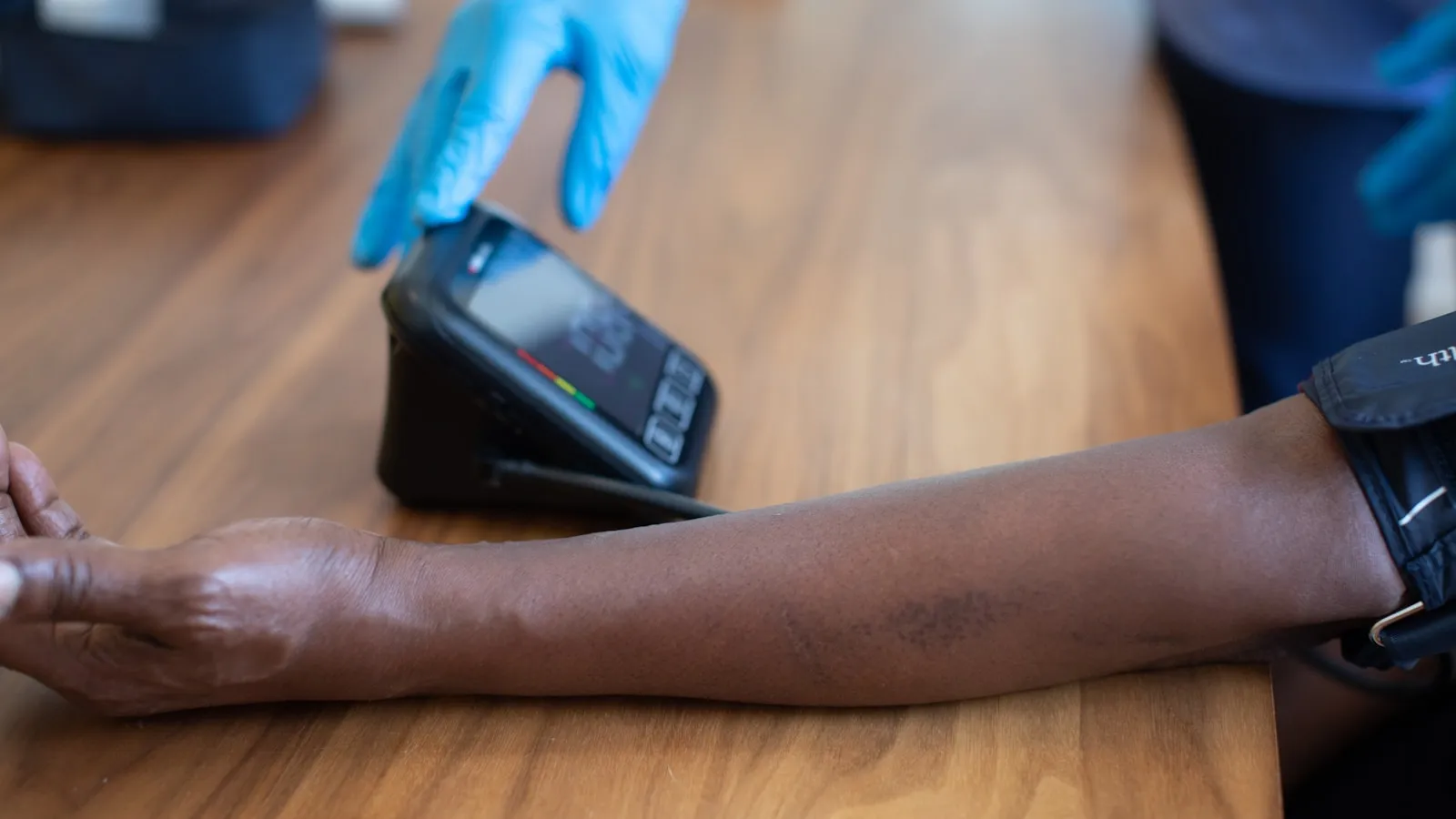
Metabolic syndrome is not a disease but a cluster of five risk factors that often occur together: waist circumference, triglycerides, HDL cholesterol, blood pressure and fasting glucose. Meet three or more of them and doctors speak of the syndrome.
Three of those five sit on an ordinary blood report. The other two you measure with a tape measure and a blood pressure monitor.
Watch the units. Nearly every page on this subject quotes the thresholds in mg/dl, and those cannot be laid alongside a Dutch report in mmol/l.
What are the five criteria?
Five measurements, each with its own cut-off. The international definition was harmonised in 2009 by seven organisations, among them the International Diabetes Federation and the American Heart Association, so that laboratories and doctors worldwide apply the same limits (Alberti et al., 2009).
Below they are given in mmol/l, the unit printed on a Dutch report.
| Criterion | Threshold (European population) | Where you find it |
|---|---|---|
| Waist circumference | 94 cm or more in men, 80 cm or more in women | Tape measure, on bare skin at navel height |
| Triglycerides | 1.7 mmol/l or above | Lipid panel, drawn fasting |
| HDL cholesterol | Below 1.0 mmol/l in men, below 1.3 mmol/l in women | Lipid panel |
| Blood pressure | 130/85 mmHg or above, or already treated | Blood pressure monitor |
| Fasting glucose | 5.6 mmol/l or above, or already treated | Blood report, drawn fasting |
The waist thresholds differ by population. The 2009 statement deliberately left that limit open to national definition, because the risk at a given circumference is not the same everywhere. For people of European descent, 94 and 80 cm are usually applied.
Treatment counts as a criterion. If you already take blood pressure medication, that box is ticked even when your measured pressure is normal now.
Picture someone with a waist of 98 cm, triglycerides of 1.9 mmol/l and an HDL of 0.9 mmol/l. They already meet three criteria, while their glucose is 5.2 mmol/l and their blood pressure 124/78 mmHg.
Their blood sugar is entirely normal.
They still count, because the definition asks for three of the five and not specifically for the sugar value. That is exactly why people rarely recognise themselves here: the criterion everyone thinks of is the one that is fine.
What symptoms does metabolic syndrome cause?
Almost none, which is exactly why it is so often found by accident. None of the five criteria hurts. Raised blood pressure, raised fasting glucose and abnormal fat values all three run silently, sometimes for years.
What people do notice is the waistline.
That is also the most usable signal, because it is the only criterion you can check at home without equipment. A tape measure costs almost nothing. Measure on bare skin, at the end of a normal breath out, roughly at navel height.
The Dutch Hartstichting calls waist circumference a practical first measure alongside the number on the scales for that reason. Two people at the same weight can carry very different fat distributions, and distribution counts for more here than the number does.
Why do these five belong together?
Because the same mechanism sits underneath all five: reduced sensitivity to insulin. Insulin resistance affects how your body handles fats, how your kidneys retain sodium and how your liver releases glucose. That explains why these abnormalities appear in groups rather than singly.
The combination of high triglycerides with a low HDL is the clearest example.
Those two almost always move in opposite directions when insulin sensitivity falls, and together they make up two of the five criteria. So anyone watching only total cholesterol misses the pattern that matters here. How that mechanism works is covered in insulin resistance.
A raised uric acid is not among the official five, but turns up more often in the same group of people.
How common is it in the Netherlands?
More common than most people assume. Estimates for Dutch adults between thirty and seventy run towards a third of men and a quarter of women, depending on which definition and which age band is applied.
Those percentages are estimates, not counts.
What is counted is diabetes. According to RIVM figures, more than 1.2 million people in the Netherlands had diagnosed diabetes mellitus in 2024, the large majority of it type 2. Metabolic syndrome precedes a substantial share of that.
The stage in between has its own name and its own values, described in prediabetes.
What can you do about it?
Work on several criteria at once, because they share a cause. Losing weight around the abdomen tends in practice to improve triglycerides, HDL, blood pressure and fasting glucose in one movement. That is the advantage of a cluster with a single engine.
The size of that effect has been measured in large trials.
In the Diabetes Prevention Program, a lifestyle programme in 3,234 participants with impaired glucose tolerance cut new diabetes cases by 58 percent, against 31 percent for metformin (Knowler et al., 2002). The changes involved were modest, not extreme diets.
Of the five criteria, triglycerides usually respond fastest. What concretely helps there is covered in lowering triglycerides.
Which values should you have drawn?
The three you cannot measure yourself, in a single fasting draw: triglycerides, HDL cholesterol and fasting glucose. Waist and blood pressure you do at home. That gives you all five criteria complete.
Fasting is not a detail here but a condition.
Triglycerides rise sharply after a meal, so a non-fasting result can push you over the 1.7 mmol/l line without cause. The GLP-1 baseline panel contains these three values alongside your liver and kidney values, and a BIG-registered doctor assesses the result.
Always discuss a result with three or more abnormal criteria with your GP. They weigh in what your family history, your medication and your blood pressure over time are showing.
What I would look at myself
The tape measure, first. Of the five criteria, waist circumference is the only one you can check tonight, and it tracks the other four most closely. It is still the measurement most often skipped in the consulting room.
What strikes me about this subject is how often the wrong units get copied across.
A triglyceride value of 150 sounds alarming until you notice it is mg/dl, which works out at 1.7 mmol/l. Put your own result next to the table above and check which unit is printed after your number.
References
- Alberti KGMM et al. Harmonizing the metabolic syndrome: a joint interim statement. Circulation. 2009. PMID 19805654
- Knowler WC et al. Reduction in the incidence of type 2 diabetes with lifestyle intervention or metformin. N Engl J Med. 2002. PMID 11832527
- RIVM, figures on diabetes mellitus in the Netherlands (2024).
- Hartstichting, information on waist circumference and risk factors.
- NHG guideline on type 2 diabetes, cut-off values for fasting glucose.
Every blood test result includes a professional assessment from a BIG-registered doctor. Discuss your result with your GP before changing anything about your treatment.
Author
SlimmerLab
Dr. Naimi, BIG-registered physician, oversees the medical standards behind our content and assessments. Read our medical policy
Related Tests
Related Posts

Lowering triglycerides: what works and what your blood shows

Calculating HOMA-IR: what the index says about insulin sensitivity