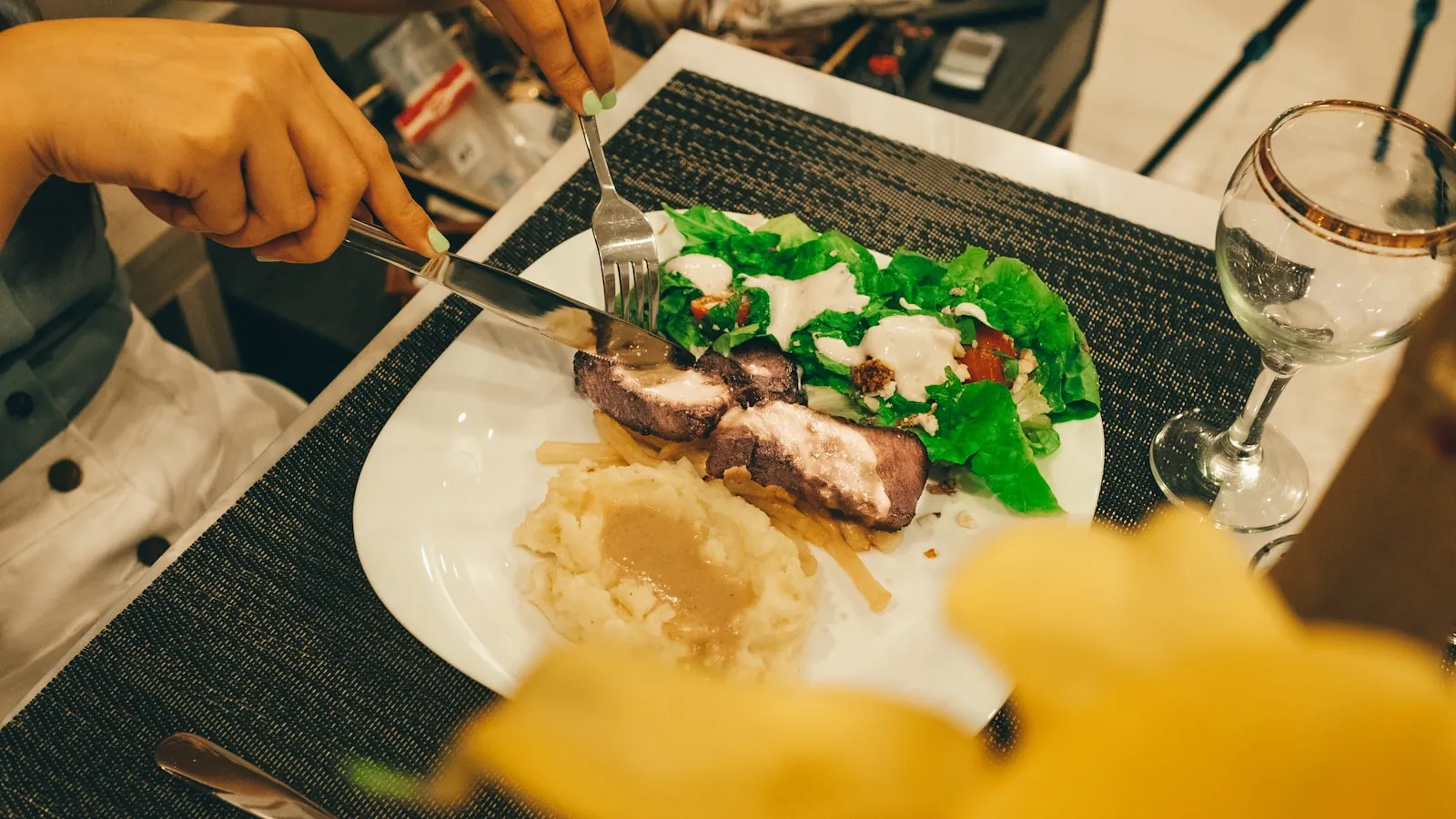
What not to eat on Ozempic comes down in practice to portion size and fat. Large, fatty and fried meals are mentioned most often as a trigger for nausea, along with alcohol and carbonated drinks. In the STEP 1 trial, over 70 percent of participants reported gastrointestinal complaints.
There is no banned list in the package leaflet. There is a note that the symptoms are usually mild and ease over the weeks.
And here sits a misunderstanding we run into almost everywhere. Nearly every article states that semaglutide slows your stomach, full stop. In the Friedrichsen study there was no evidence of that left at week 20. Spontaneous energy intake was 35 percent lower though.
So the gastric delay is mostly an early-weeks phenomenon. What stays is a sharply reduced appetite.
That changes the question. It is less about forbidden food and more about what still fits, and what still gets in.
1. Large portions, whatever is on the plate
This is the most reported trigger, and it is not a food but a quantity. Fullness arrives earlier and harder than you are used to, and carrying on past that point is what brings on the nausea. Most people discover this once and never again.
Half a plate that gets finished sits better than a full plate half finished.
Imagine someone on 1 mg semaglutide who ate a portion of chips in week 3 and spent the evening feeling ill. In week 30 the same portion went down without trouble. The drug had not changed, the body had adjusted.
That is the pattern we hear most often: the window in which things go wrong is narrower than people fear.
2. Fried and very fatty food
Fat stays in the stomach longest. Chips, fried snacks and heavy sauces are therefore usually the first things named when something does not sit well.
There is something else in play. The Dutch prescribing reference Farmacotherapeutisch Kompas lists pancreatitis as a rare adverse effect of GLP-1 medicines, with persistent severe abdominal pain as the warning sign. Fatty food is not the cause of that, but abdominal pain after a rich meal is the moment people start wondering.
Amylase and lipase are the tests that belong to that question.
3. Alcohol
Alcohol irritates the stomach lining and amplifies nausea. It also affects blood sugar. For people also using insulin or a sulfonylurea, the combination can raise the risk of a hypo.
Many users also report that their desire for alcohol falls away on its own.
That last point is one of the most striking things about these drugs, and it is now being studied seriously.
4. Carbonated drinks
Carbonation expands in a stomach that already feels full sooner. Soft drinks and sparkling water therefore bring on bloating and burping more quickly.
Still water sits better for most people, certainly in the days after an injection.
5. Sugary soft drinks and fruit juice
Liquid sugars produce a fast blood sugar peak without providing fullness. That works against the effect you are trying to get from the medicine, and it is one of the few points where food and blood value connect directly.
Fasting glucose and HbA1c are the values where this eventually shows up.
6. Heavily spiced food
Spicy food worsens heartburn and stomach irritation for many people, and those complaints are more common on GLP-1 medicines. This one is clearly personal: some users notice nothing at all.
Try it on a day when you otherwise feel fine, not on the day after a dose increase.
7. Tough or fatty meat
Large pieces of meat sit heavily and often get pushed aside halfway. That is a shame, because protein is exactly what you want to keep in during weight loss.
Softer protein sources such as fish, eggs, quark and pulses are usually tolerated better.
Honestly, I would give up the form before the amount here. The steak can go, the protein preferably not.
The Dutch nutrition authority Voedingscentrum uses roughly 0.8 grams of protein per kilo of body weight per day for adults, and that gets harder to reach the less you eat.
8. Large amounts of full-fat dairy
Full-fat dairy combines fat with lactose, and both can act up when digestion is slow. Cream, large servings of full-fat yoghurt and ice cream come up regularly for that reason.
Smaller portions of lower-fat versions deliver the protein without the same fat load.
9. A plate with no fibre and no fluid
This is the reverse point: not what you eat, but what is missing. Constipation is a commonly reported complaint, and it worsens with little fibre and little drinking. When portions shrink sharply, vegetables and wholegrains are often the first things to leave the plate.
Dehydration plays a part here too, and that one is visible in blood testing: creatinine rises with persistent vomiting or diarrhoea.
What you can follow in blood
Not every complaint has a blood value. The table shows which ones do.
| Complaint | What often sits behind it | Related test |
|---|---|---|
| Persistent vomiting or diarrhoea | Fluid loss | Creatinine and sodium |
| Severe, persistent abdominal pain | Rare: pancreatitis | Lipase and amylase |
| Shaking or sweating after alcohol | Low blood sugar, mainly alongside insulin | Fasting glucose |
| Eating little, little protein | Thinned-out nutrition | Albumin, ferritin, vitamin B12 |
What you can do with this
Our summary is less strict than most lists: there is no food you are not allowed to eat on Ozempic. There are portion sizes and fat levels that sit badly while your body adjusts, and there is a real chance your protein and fibre intake quietly drops too low.
If nausea, vomiting or abdominal pain lasts longer than a few days, call your doctor or pharmacist rather than cutting more foods.
If you want to know what a few months of eating less has done to your values, that sits in the three-month check. More on the complaints themselves is in our overview of Ozempic side effects.
Every blood test result includes a professional assessment from a BIG-registered doctor. For treatment decisions, discuss your results with your GP.
References
- Friedrichsen M, Breitschaft A, Tadayon S, et al. The effect of semaglutide 2.4 mg once weekly on energy intake, appetite, control of eating, and gastric emptying in adults with obesity. Diabetes Obes Metab, 2021. PMID 33269530.
- Wilding JPH, Batterham RL, Calanna S, et al. Once-weekly semaglutide in adults with overweight or obesity (STEP 1). N Engl J Med, 2021. PMID 33567185.
- Jastreboff AM, Aronne LJ, Ahmad NN, et al. Tirzepatide once weekly for the treatment of obesity (SURMOUNT-1). N Engl J Med, 2022. PMID 35658024.
- Farmacotherapeutisch Kompas, semaglutide monograph.
- Voedingscentrum, protein and fibre.
الكاتب
SlimmerLab
Dr. Naimi، طبيب مسجل في سجل BIG الهولندي، يشرف على المعايير الطبية لمحتوانا وتقييماتنا. اقرأ سياستنا الطبية
فحوصات ذات صلة
مقالات ذات صلة
Lowering triglycerides: what works and what your blood shows

Calculating HOMA-IR: what the index says about insulin sensitivity