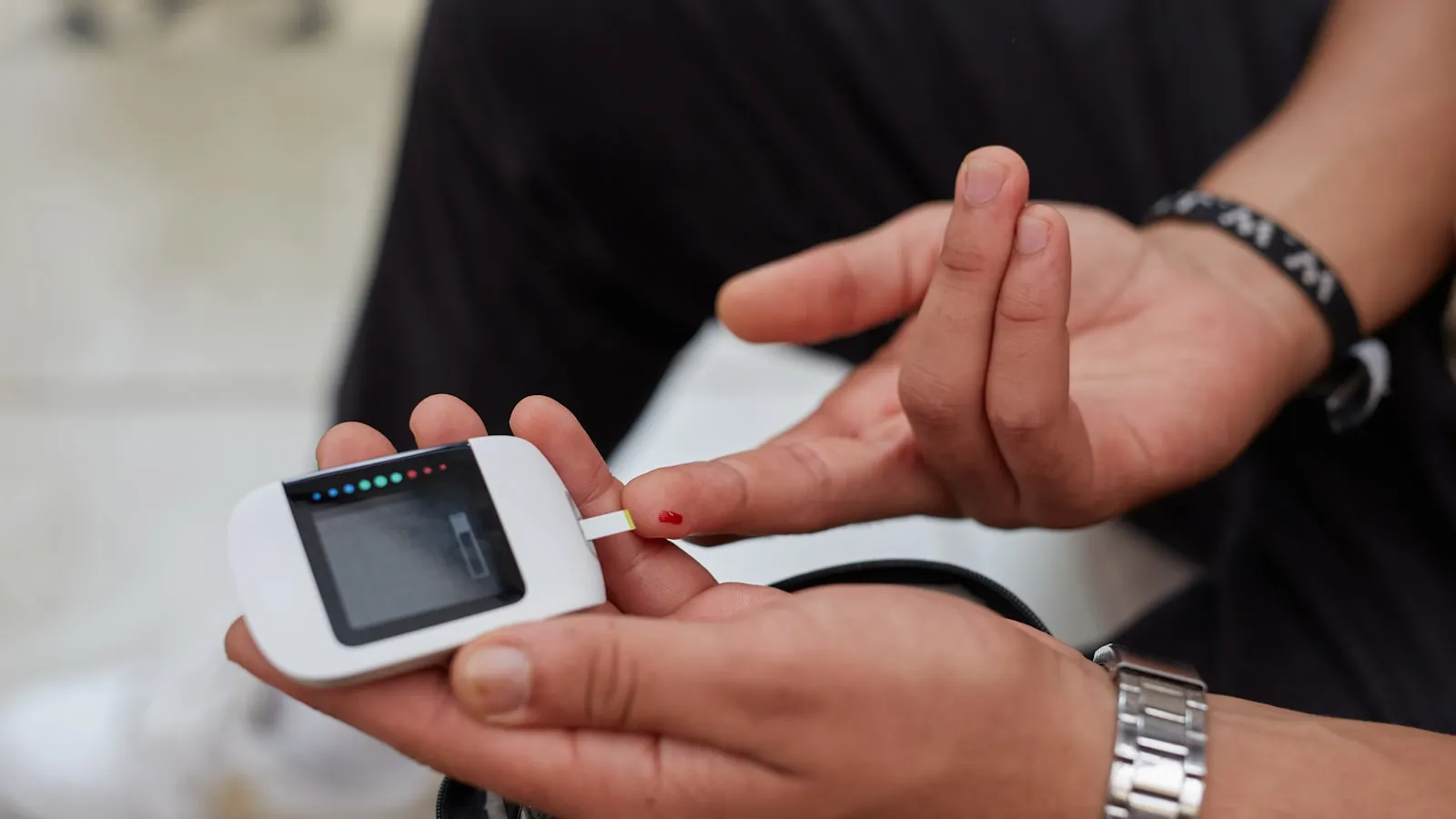
Losing weight with type 2 diabetes lowers your blood sugar, improves your HbA1c and can even put the condition into remission. At a loss of fifteen kilos or more, 86% of participants in the DiRECT trial reached remission. That makes it the most effective intervention available for this condition.
There is one catch that almost no page mentions.
If you lose weight while taking insulin or certain tablets, your medication gradually becomes too strong for your own body. That is a conversation with your GP beforehand, not afterwards.
Why is losing weight harder with type 2 diabetes?
Because the condition and the weight sustain each other. In type 2 diabetes your cells respond less well to insulin, so your pancreas makes more of it. High insulin levels push fat into storage and make breaking fat down harder.
So you are working against your own hormones.
On top of that, some diabetes medicines cause weight gain themselves, while others are weight-neutral or actively help. Which one you take changes your starting position. The Dutch NHG guideline for type 2 diabetes sets out the order in which GPs introduce these drugs.
How much weight loss is needed?
Less than most people think for improvement, and a fair amount for remission. In DiRECT, participants received a total diet replacement and lost an average of 10 kilos. After a year, 46% were in remission against 4% in the control group (Lean et al., 2018).
The chance tracked the kilos directly.
| Weight loss | Chance of remission in DiRECT |
|---|---|
| Gained weight | 0% |
| Small loss | 7% |
| 5 to 10 kilos | 34% |
| 10 to 15 kilos | 57% |
| 15 kilos or more | 86% |
Participants had had diabetes for under six years and were not on insulin, so these figures do not transfer wholesale to everyone. What they do show is that the return scales with what you lose.
What happens to your medication as you lose weight?
It gradually becomes stronger than you need. As you lose weight, your sensitivity to insulin recovers. The same dose that was exactly right at the start can then become too much, with a low blood sugar as the result.
This does not apply equally to every drug.
Two people both lose fourteen kilos over four months. The first takes only metformin and notices almost nothing of this effect. The second takes gliclazide and starts getting shaky, sweaty and lightheaded between meals. The same kilos, but for the second the dose has stayed the same while the body it was set for has not.
Insulin and the sulfonylureas, such as gliclazide, can cause a hypo on their own. Metformin and the GLP-1 drugs essentially do not, because they only act when your blood sugar is high. In DiRECT the diabetes medication was therefore withdrawn beforehand, before the diet began.
Never change a dose yourself. Discuss with your GP how your medication should move alongside your weight before you start, and ask what to do about symptoms suggesting a hypo. Thuisarts describes how to recognise a low blood sugar.
Which values move, and how fast?
Your fasting glucose responds fastest, your HbA1c follows with a delay. Glucose can fall visibly within weeks. HbA1c is an average across roughly three months, so by definition it lags behind what is happening now.
That difference in pace confuses a lot of people.
A disappointing HbA1c after six weeks says little, because it largely describes the period before. Fasting glucose and fasting insulin give a more current picture, and HbA1c confirms it later.
Your insulin value is the most interesting of the three, because it shows how much work your pancreas still has to do for the same result.
What does remission actually mean?
That your blood sugar values are normal without diabetes medication. DiRECT defined remission as an HbA1c under 48 mmol/mol after at least two months off all drugs. It is emphatically not a cure: if the weight comes back, the diabetes usually comes with it.
Remission is a state, not a finish line.
That makes keeping the weight off more important than losing it. According to the Dutch RIVM, over a million people in the Netherlands live with diabetes, the large majority type 2, so this is a large group for whom it could be achievable.
What role do the newer drugs play?
They make the weight loss achievable where diet alone often is not. Semaglutide produced an average loss of 14.9% over 68 weeks in STEP 1 (Wilding et al., 2021). In SURPASS-2, compared directly in people with type 2 diabetes, HbA1c fell 2.30 percentage points on tirzepatide against 1.86 on semaglutide (Frías et al., 2021).
Which drug is appropriate for you is decided by your GP or internist.
The full overview of available drugs is in weight-loss medication, and why the newest generation acts on two hormones is in the GIP hormone.
What is worth measuring before you start
Your baseline, because without it there is no way to establish later what actually changed. Glucose, insulin and HbA1c together show where you are starting from. Your liver and kidney values belong with them, because they move too and because some diabetes drugs lean on them.
The GLP-1 baseline panel records that, assessed by a BIG-registered doctor. It remains a course you walk with your own GP, particularly if you take medication.
How fast weight loss without supervision plays out is covered in the crash diet.
What I think about it
That the medication conversation is missing too often. The pages ranking well for this question all give nutrition and exercise advice, and not one of them mentions that your own medication scales with your success. That is precisely where it goes wrong for people who start on their own.
What strikes me about DiRECT is how carefully they did handle it.
The medication came off first, and only then the weight. That order is not a detail. Make an appointment with your GP before you begin, and have your baseline measured, so that later you know what genuinely changed.
References
- Lean MEJ et al. Primary care-led weight management for remission of type 2 diabetes (DiRECT): an open-label, cluster-randomised trial. Lancet. 2018. PMID 29221645
- Wilding JPH et al. Once-Weekly Semaglutide in Adults with Overweight or Obesity (STEP 1). N Engl J Med. 2021. PMID 33567185
- Frías JP et al. Tirzepatide versus Semaglutide Once Weekly in Patients with Type 2 Diabetes (SURPASS-2). N Engl J Med. 2021. PMID 34170647
- NHG guideline Diabetes mellitus type 2 (treatment order and medication).
- Thuisarts, information on low blood sugar and how to recognise it.
- RIVM, figures on diabetes in the Netherlands.
Every blood test result includes a professional assessment from a BIG-registered doctor. Never change your diabetes medication yourself. Talk to your GP before you start losing weight.
Autor
SlimmerLab
Dr. Naimi, lekarz wpisany do holenderskiego rejestru BIG, nadzoruje standardy medyczne naszych treści i ocen. Przeczytaj naszą politykę medyczną
Powiązane badania
Powiązane artykuły
Lowering triglycerides: what works and what your blood shows
Calculating HOMA-IR: what the index says about insulin sensitivity