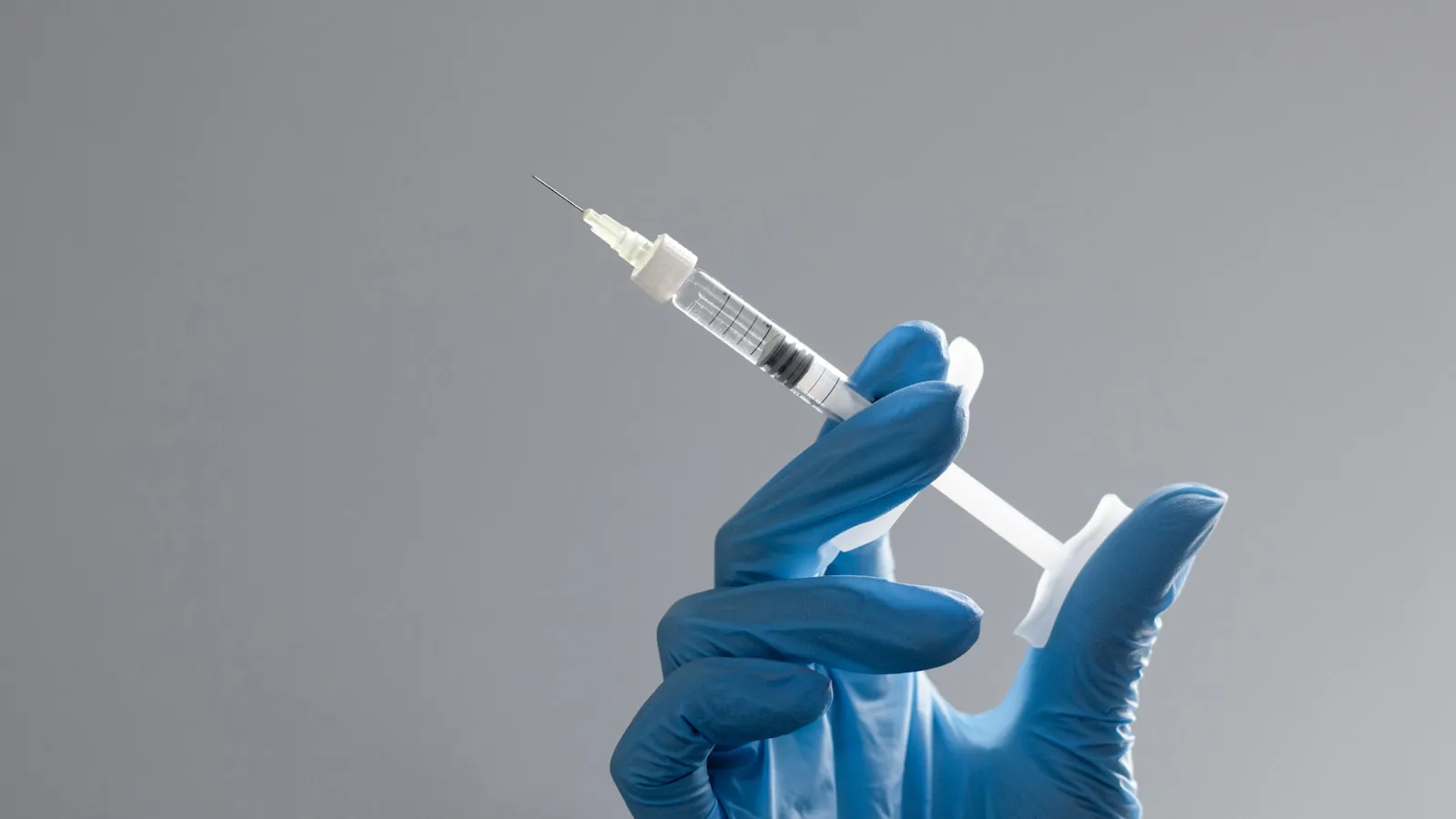
Administering Ozempic happens once a week, with a prefilled pen, as an injection under the skin of your abdomen, thigh or upper arm. You pick one fixed day of the week and stick to it. The pen handles the dosing itself; you turn the dose selector to the number your doctor prescribed.
This is an explanation of what happens and why, not a set of instructions.
The technique itself is in the leaflet that came with your own pen, and your pharmacy or practice nurse will go through it with you. What is not in there, and what almost no page covers, is which blood values move along with that weekly rhythm.
Why once a week and not daily?
Because semaglutide has a half-life of roughly one week. The molecule is built to break down slowly, so the concentration in your blood barely drops between two injections. That means a single weekly injection is enough to hold an almost constant level.
Which is exactly why the fixed day matters.
Keep shifting it by a few days and the level swings more than intended. The Dutch Farmacotherapeutisch Kompas sets out the conditions under which an injection day may be moved. That is a question for your prescriber, not for a blog.
Where does the injection go?
Under the skin of the abdomen, thigh or upper arm. That is fat tissue rather than muscle, and absorption from it is even. Users rotate the spot so the same patch of skin is not punctured over and over.
That rotation is about your skin, not about how well it works.
With semaglutide the chosen site makes little difference to absorption, unlike some insulins. Hardening or irritation of the skin in one fixed spot is the reason to rotate. Thuisarts describes how to assess an injection site and when skin complaints are a reason to make contact.
Why does everyone start on a low dose?
To keep the nausea manageable. GLP-1 drugs slow your stomach emptying, and that is precisely the side effect that makes people quit. Building up in steps gives your gut time to adjust, which usually reduces the complaints.
In the STEP 1 trial the dose was built up in steps across sixteen weeks before the target was reached. Participants then lost an average of 14.9% of their body weight over 68 weeks, against 2.4% on placebo (Wilding et al., 2021).
Your own schedule is set by your doctor, not by this trial.
The full list of complaints most common during that build-up is in Ozempic side effects. How the drug itself works is in the GLP-1 injection.
When should you have blood drawn around the injection?
For most values, the day within your injection week does not matter. Your HbA1c is an average across roughly three months and does not track a single injection. Fasting glucose is more sensitive, but is driven mainly by what you ate the day before.
Take two people who both come out at an HbA1c of 51 mmol/mol at 3 months. One was drawn the day after their injection, the other six days later. That difference does not show up in the result, because this value describes the past three months rather than the past week.
| Moment | What is happening then | Worth measuring |
|---|---|---|
| Before the first injection | No drug effect at all yet | Your full baseline |
| Week 1 to 4 | Build-up phase, complaints at their worst | Rarely anything, unless symptoms appear |
| Around 3 months | Weight falling, HbA1c following | Sugar, liver and kidney values |
| Around 6 months | Enzyme values reach their plateau | The full picture again |
Those six months are not an arbitrary choice. In the LEADER trial, lipase and amylase rose across the first six months and stayed stable afterwards (Steinberg et al., 2017). What a raised result there means is covered in elevated lipase.
How long do you keep injecting?
For as long as you want to keep the effect, because the drug cures nothing. That sounds blunt, but it is what the research shows. In the follow-up to STEP 1, roughly two-thirds of the lost weight had returned by week 120 in participants who had stopped (Wilding et al., 2022).
That makes stopping a decision with consequences rather than a finish line.
Exactly what changes when you come off is in stopping Ozempic. The difference with the weekly competitor is in Ozempic or Mounjaro.
What the leaflet answers better than we do
Everything to do with technique and dosing. How many units you dial, what to do about a missed injection, how to store the pen and how long it keeps once opened: that is documented per pen and differs by brand and strength.
We do not sell this drug and we do not prescribe it.
Where we do add something is the layer underneath. Many people get their pen online or through a clinic, receive an instruction with it, and get no measurement plan at all. The GLP-1 baseline panel records your starting values before you begin, assessed by a BIG-registered doctor.
What I would watch myself
The first six months, because almost everything happens inside them. Complaints peak, the build-up runs its course, and the values that move are finding their new level in that same window. Anyone whose first blood draw comes a year in misses that entire movement.
What strikes me about this topic is how thoroughly the injection technique gets explained everywhere, and how quiet it stays about the rest.
Go through your pen with your pharmacy, and have your baseline measured before the first injection.
References
- Wilding JPH et al. Once-Weekly Semaglutide in Adults with Overweight or Obesity (STEP 1). N Engl J Med. 2021. PMID 33567185
- Wilding JPH et al. Weight regain and cardiometabolic effects after withdrawal of semaglutide (STEP 1 extension). Diabetes Obes Metab. 2022. PMID 35441470
- Steinberg WM et al. Amylase, Lipase, and Acute Pancreatitis in People With Type 2 Diabetes Treated With Liraglutide (LEADER). Diabetes Care. 2017. PMID 28476871
- Farmacotherapeutisch Kompas, semaglutide monograph (administration and dosing).
- Thuisarts, information on injecting and skin complaints at the injection site.
Every blood test result includes a professional assessment from a BIG-registered doctor. For administration and dosing, always follow the leaflet and the instructions of your own prescriber.
الكاتب
SlimmerLab
Dr. Naimi، طبيب مسجل في سجل BIG الهولندي، يشرف على المعايير الطبية لمحتوانا وتقييماتنا. اقرأ سياستنا الطبية
فحوصات ذات صلة
مقالات ذات صلة

Lowering triglycerides: what works and what your blood shows

Calculating HOMA-IR: what the index says about insulin sensitivity